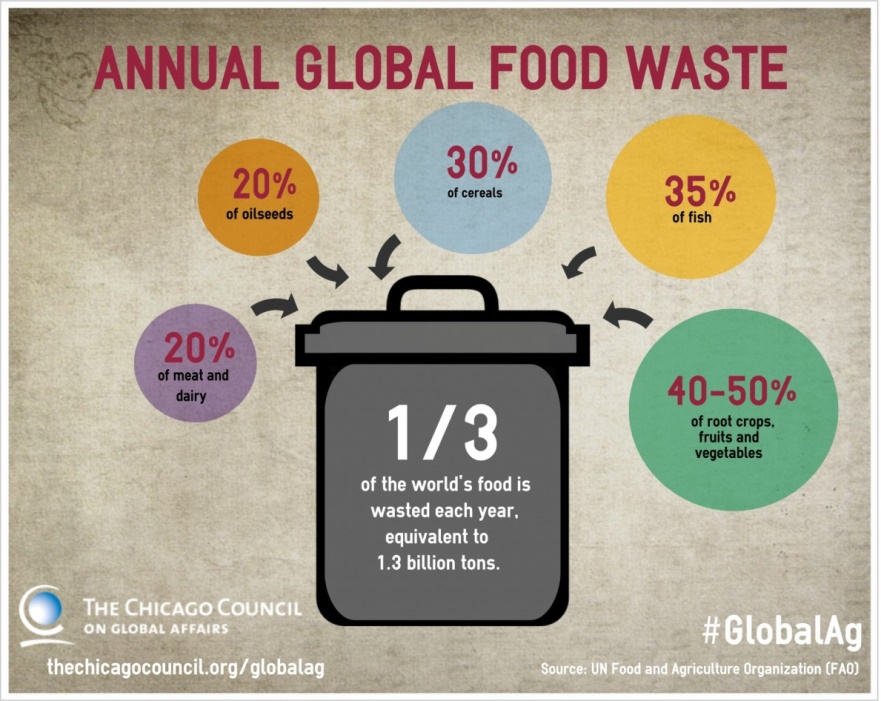
Food waste is the discarding of edible food, which happens across the entire supply chain from farms to consumers. It contributes to environmental problems like greenhouse gas emissions from landfills and a waste of resources like water, land, and energy used to produce the food.
Solutions include implementing better storage, meal planning, and consumer habits like using leftovers, as well as preventing food loss through improved infrastructure and practices at the production level.
Global Food Waste – Key Facts and Details (Latest Data as of 2025)
How Much Food Is Wasted Globally
Approximately 1.3 billion tonnes of food produced for human consumption is lost or wasted every year.This equals roughly one-third (33%) of all food produced globally.In terms of calories: about 24% of all food calories produced are never eaten.Updated UNEP Food Waste Index Report 2024: global food waste in 2022 was 1.05 billion tonnes (excluding pre-harvest losses and inedible parts in some calculations), but when including all stages, the 1.3 billion tonne figure still holds as the most commonly cited.
Key facts and figures
Amount of waste:In 2022, the world generated 1.05 billion tonnes of food waste. This is equivalent to roughly one-fifth of all food available to consumers.
Source of waste:In middle- and high-income countries, most waste happens at the household (60%), food service (28%), and retail (12%) levels. In low-income countries, food is more likely to be lost during the early and middle stages of the supply chain, such as in agricultural production
Environmental impact:Food waste is a significant contributor to climate change, accounting for 8–10% of all global greenhouse gas emissions. When food decomposes in landfills, it releases methane, a powerful greenhouse gas
Resource consumption:Producing food that is not eaten consumes vast amounts of resources. Globally, this includes using a land area larger than China, and almost a quarter of the water used in agriculture
Economic cost:The economic cost of this waste is estimated to be over $1 trillion annuall
Addressing global food waste
Countries and international bodies are working to reduce waste through policy changes and investments in infrastructure, especially cold chains in developing nations, to prevent loss after harvest.Tackling food waste requires a collaborative approach involving farmers, food processors, retailers, and consumers