Hook with: “On February 1, 2026, FM Nirmala Sitharaman unveiled a continuity-focused Budget prioritizing youth power, manufacturing scale-up, and fiscal prudence amid global uncertainties. With total expenditure at ~₹53.5 lakh crore and capex at ₹12.2 lakh crore (3.1% of GDP), it’s a roadmap for sustained 7%+ growth.” (200–300 words; mention no major tax slab changes for stability.)
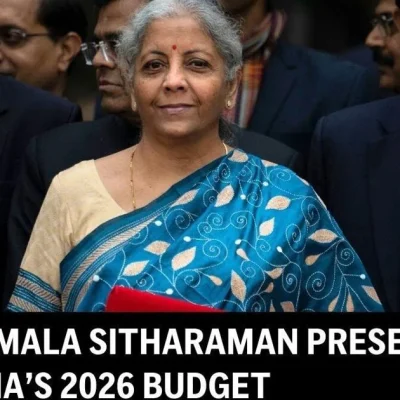
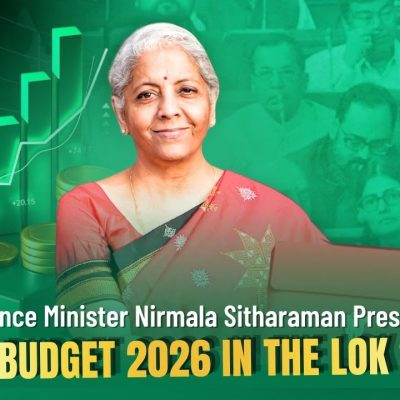
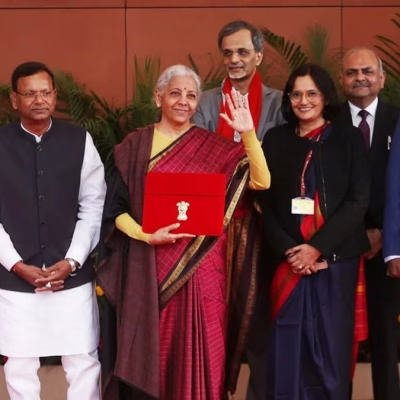
(Imagine: FM Nirmala Sitharaman presenting the Budget in Parliament.)
A Historic Sunday Budget for Viksit Bharat
The Union Budget 2026-27, presented on February 1, 2026 (a Sunday for the first time), marks FM Nirmala Sitharaman’s ninth consecutive presentation. Titled a Yuva Shakti-driven Budget, it aims to transform “aspiration into achievement and potential into performance” by harnessing India’s demographic dividend. With total expenditure at ₹53.47 lakh crore (up ~7.7%), it balances growth acceleration, fiscal consolidation, and inclusive progress amid global uncertainties.
Key numbers reflect continued fiscal discipline while prioritizing investment:
Total Expenditure: ₹53.47 lakh crore.
Capital Expenditure (Capex): ₹12.2 lakh crore (3.1% of GDP), up from ₹11.2 lakh crore to boost infrastructure and crowd in private investment.
Fiscal Deficit: Targeted at 4.3% of GDP (down from 4.4% in RE 2025-26).
Debt-to-GDP Ratio: Aiming for 50% ±1% by 2030-31 (estimated 55.6% in BE 2026-27).
Nominal GDP Growth Assumption: Around 10%.
This approach sustains public investment momentum while reducing debt burdens over time.
The Three Kartavyas: Guiding Principles of the Budget
First Kartavya — Accelerate and sustain economic growth through productivity, competitiveness, and resilience.
Second Kartavya — Fulfil people’s aspirations by building capacity and making them partners in prosperity.
Third Kartavya — Align with Sabka Sath, Sabka Vikas for inclusive access to resources and opportunities.
These principles drive targeted interventions across sectors.
Focus on Youth and Skilling (Yuva Shakti)
A core theme: Converting India’s demographic dividend into productive capacity.
Emphasis on skilling youth for emerging technologies (AI, semiconductors, deep-tech).
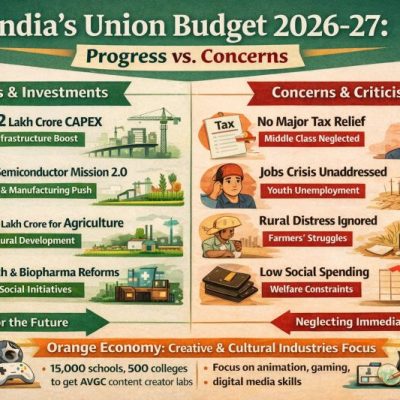
Upskilling initiatives, including 10,000 tourist guides and AVGC (Animation, Visual Effects, Gaming, Comics) labs in schools/colleges.
High-Powered Committee for “Education to Employment and Enterprise” to assess job impacts of tech.
This positions youth as drivers of growth and employment.
Boost to Manufacturing and Strategic Sectors
Major push for self-reliance and global competitiveness:
Biopharma SHAKTI: ₹10,000 crore over 5 years for biologics/biosimilars hub.
ISM 2.0: Enhanced semiconductor mission for equipment, materials, and IP.
Electronics Components Manufacturing Scheme outlay hiked to ₹40,000 crore.
Schemes for rare earth magnets, chemical parks, textiles, containers, and legacy cluster revival.
Focus on 7 strategic/frontier sectors to reduce import dependencies.
Infrastructure and Energy Security Push
Capex Emphasis: ₹12.2 lakh crore for roads, rail (7 high-speed corridors), and urban development in Tier II/III cities.
Energy: ₹20,000 crore for Carbon Capture, Utilization, and Storage (CCUS); exemptions for critical minerals and clean energy.
Infrastructure Risk Guarantee Fund and rail freight corridors.
These aim to create jobs and long-term economic multipliers.
Outlook and Implications
The Budget sustains capex-led growth while consolidating fiscally, targeting Viksit Bharat by balancing ambition with inclusion. It could drive 7%+ real GDP growth if executed well, benefiting youth, businesses, and rural India. Challenges include global volatility and implementation speed.
What are your thoughts on the Budget? Will it accelerate India’s manufacturing edge? Share in the comments!
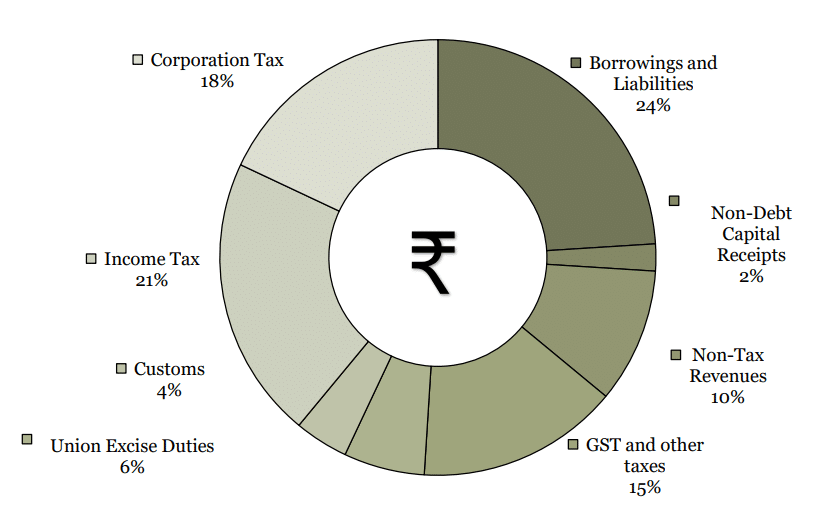
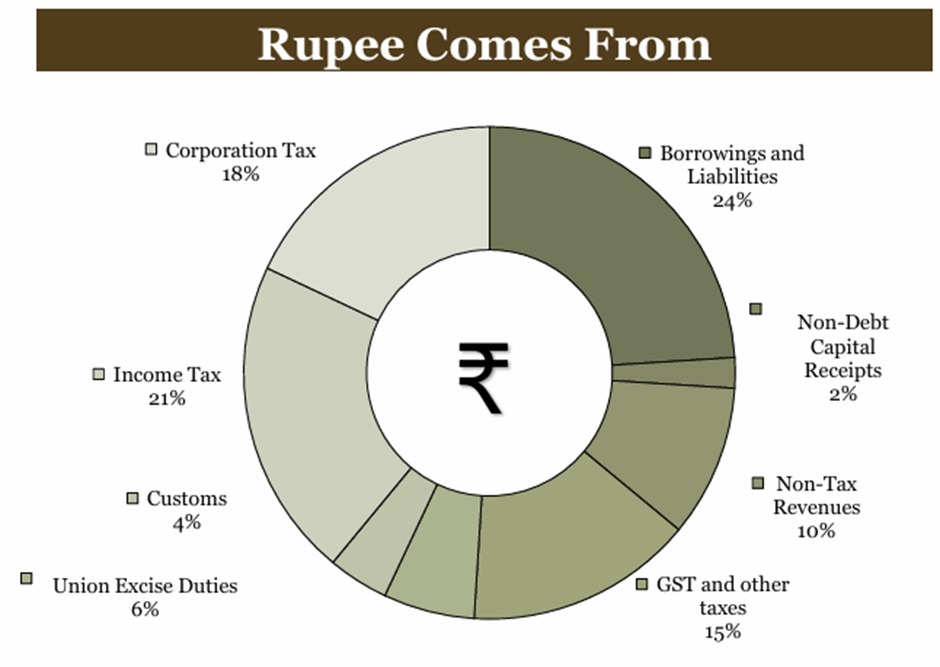
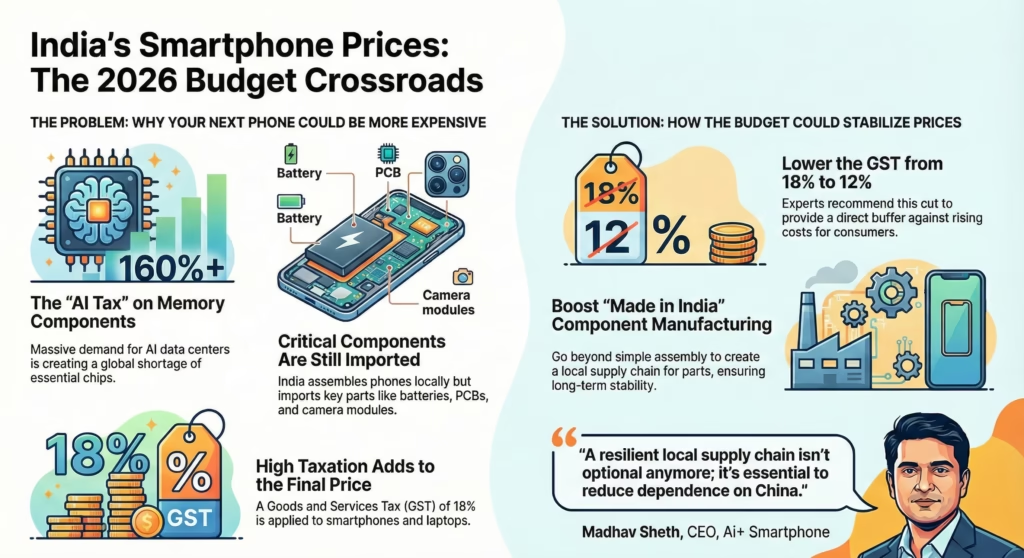
For visuals, embed the infographics above (revenue/expenditure pies, key allocations) to make your blog more engaging. Sources: Official PIB, indiabudget.gov.in, and credible analyses. Let me know if you need sub-sections expanded!
You Can Watch About Union Budget Here
You Can Read About The Union Budget Here
Find information in faster & easier ways with AI Overviews in Google Search
Which place has the highest budget allocated/utilized in 2026?
Conclusion Of Union Budge 2026
The Union Budget 2026-27, presented by Finance Minister Nirmala Sitharaman, acts as a pivotal blueprint for “Viksit Bharat 2047,” balancing ambitious growth with fiscal discipline. Anchored in three core “kartavyas”—accelerating growth, fulfilling aspirations, and inclusive development—the budget aims for a 7%+ GDP growth rate through a record ₹12.2 lakh crore capital expenditure (4.4% of GDP).Key takeaways show a strong focus on self-reliance (Swadeshi) and industrial modernization, featuring the India Semiconductor Mission (ISM) 2.0, Bio-pharma SHAKTI, and a ₹10,000 crore SME Growth Fund to bolster MSMEs. The budget also advances green energy with a ₹20,000 crore Carbon Capture (CCUS) scheme and strengthens logistics via new dedicated freight corridors and 20 national waterways.On the fiscal front, the government prioritizes stability, aiming to reduce the fiscal deficit to 4.3% of GDP and lowering the debt-to-GDP ratio to 55.6%. Tax reforms, including the implementation of the new Income Tax Act, 2025, focus on simplification and enhancing compliance. Ultimately, the 2026 budget is a forward-looking, “Yuva Shakti”-driven document aiming to transform India into a robust global manufacturing and innovation hub while maintaining macroeconomic stability.